




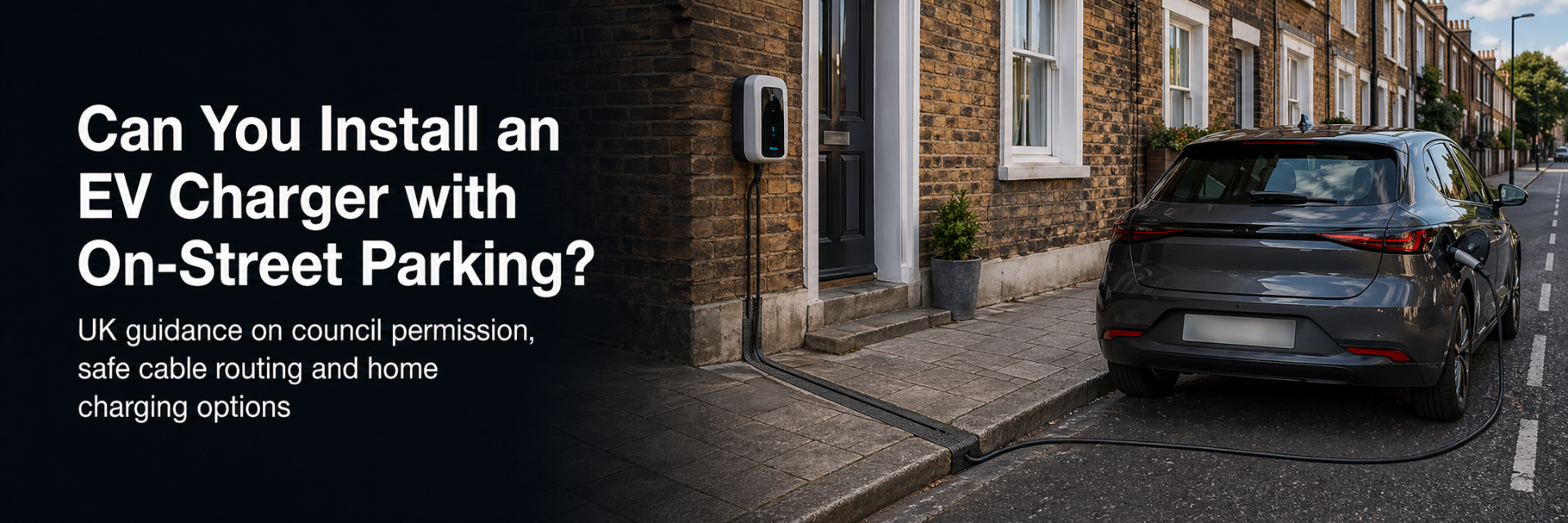
You can install an EV charger with on-street parking in some UK locations, but it is not as simple as fitting a charger and trailing a cable across the pavement. If you do not have a driveway, garage or private bay, you normally need council or highways permission before using a cross-pavement charging solution.
For most homeowners, the key question is not just “can I fit a charger?” It is “can I legally and safely get the charging cable from my property to the car?” This guide explains the main options, the permissions to check, and what to do if you cannot park directly outside your home.
Can you have a home EV charger without a driveway?
You may be able to have a home EV charger without a driveway, but the charger on your wall is only one part of the setup.
For a standard home installation, the installer usually fits a dedicated chargepoint on private property, such as an external wall near a driveway. With on-street parking, the car is on the public highway, so the cable may need to cross a pavement or verge. That brings in highways rules, pedestrian safety and local council policies.
GOV.UK guidance says cross-pavement charging solutions need permission from the local highway authority and, where required, the local planning authority. The authority will assess the proposal for traffic, pedestrian safety, accessibility and the surrounding area.
In short
The home charger may be technically possible, but the route to the vehicle must be approved.
Can you run an EV charging cable across the pavement?
You should not simply trail an EV charging cable across the pavement.
Loose cables can create trip hazards, obstruct wheelchair users, block prams, and create problems for people with visual impairments. Temporary mats or cable covers may look like an easy fix, but they are not treated the same as an approved cross-pavement installation.
The current EV Chargepoint Grant for Households with On-Street Parking says the cross-pavement solution must not be a temporary solution, such as cable covers or mats placed over a cable. It also says you must have local highways authority permission for the cross-pavement installation.
That means the safer route is usually a permanent or approved system, such as a pavement cable channel, rather than a cable lying across the footway.
What is a cross-pavement charging solution?
A cross-pavement charging solution is a fixed way to carry the EV charging cable from your property boundary to the kerb without leaving the cable loose on the pavement.
Common examples include a recessed pavement gully or cable channel. In a typical setup, the home charger is installed on your property, the cable is placed into the channel when charging, and the channel helps keep the pavement surface safer and tidier.
These systems are not something homeowners should install themselves. The public highway is controlled by the local highway authority, and GOV.UK makes clear that relevant permissions may include highways permits, Section 50 licences, traffic regulation orders and planning permission or local development orders, depending on the ownership model and location.
Your council may already have a preferred supplier, a pilot scheme, or no current policy at all. Check before buying equipment.
Do you need council permission?
Yes, if the cable crosses the public pavement or any part of the public highway, you should expect to need permission.
The grant guidance is clear: installation of a cross-pavement charging solution requires local highways authority consent. You must contact the authority to apply for and agree the installation in line with its policies, and you must not install cross-pavement solutions on the public road network yourself.
You may also need planning permission, depending on the property, location and local rules. Planning and highways functions may sit in different parts of the same council, or in different councils in two-tier areas. For example, a county council may act as the highways authority while a district council handles planning.
Ask your council before booking work
- Do you allow cross-pavement EV charging channels?
- Do you have an approved product or installer list?
- Do I need planning permission as well as highways consent?
- Who owns and maintains the channel after installation?
- What happens if the pavement needs repair work later?
Is planning permission needed for an EV charger?
For homes with off-street parking, many wall-mounted EV chargers are likely to fall under permitted development, provided they meet the relevant size and location limits. The Planning Portal says an electrical charging outlet must not exceed 0.2 cubic metres and must not be within the curtilage of a listed building or a scheduled monument site.
On-street parking is more complicated because the charger may be linked to a cross-pavement solution. Current GOV.UK grant guidance says applicants must obtain any planning permissions required by the local planning authority for the chargepoint and cross-pavement solution.
The government has also consulted on further changes to permitted development rights for EV charging, including cross-pavement solutions and associated domestic chargepoints. That consultation closed on 21 January 2026, with the outcome still listed as being analysed at the time of drafting.
Bottom line on planning
Do not assume permitted development applies. Check your council’s current position before installation.
What if you cannot park directly outside your house?
This is one of the biggest practical limits with on-street EV charging.
A home charger does not give you a reserved parking space. The on-street parking grant guidance says the grant does not give ownership, exclusive use or reserved access to a parking space outside or near your home. It also warns that you may not have constant access to the funded chargepoint.
That matters for terraced streets where parking is shared. Even if a pavement gully is approved, it may only be useful when you can park close enough for the cable to reach safely.
For terraced homes, check the parking reality first
- Can I usually park outside or very near my home?
- Is the kerbside space lawful and safe for parking?
- Would the cable route cross a main pedestrian path?
- Would the setup still work if another vehicle parked outside?
- Is nearby public charging a better day-to-day option?
If parking outside your home is unpredictable, a charger may still be useful, but it should not be your only charging plan.
Are there grants for on-street home charging?
Yes, there is a UK grant route for some households with on-street parking.
From 1 April 2026, the Electric Vehicle Chargepoint Grant for Households with On-Street Parking provides up to £500 towards the cost of buying and installing a chargepoint. To qualify, you must be installing a cross-pavement solution, such as a charging gully, and only have on-street parking.
The more detailed grant page says you can get 75% off the cost to buy and install a socket, up to a maximum of £500. It also says you must not have already installed the chargepoint, must live in the property, must not have private and exclusive off-street parking, and must have permission from your local highways authority.
Check the grant before you start, not after. The scheme cannot normally be backdated once the charger is already installed.
Who installs the charger?
A competent EV chargepoint installer should install the charger itself. For grant-funded work, GOV.UK directs applicants to contact an OZEV-approved installer for a quote.
The pavement channel is separate. Depending on your council’s policy, it may be installed by a council contractor, an approved cross-pavement supplier, or another authorised contractor working under the correct highway permissions.
Do not cut into the pavement yourself. Do not modify public highway surfaces. Do not rely on a loose extension lead or an indoor socket. EV charging is a high-load electrical use, and the installation must be designed for safe outdoor operation.
What are the alternatives if approval is not possible?
If your council does not currently allow cross-pavement charging, or your parking situation is too unpredictable, you still have options.
You could use nearby public chargers, workplace charging, supermarket chargers, rapid charging hubs or a local on-street charging scheme. Some councils are also rolling out lamp column chargers or dedicated residential chargepoints through local EV infrastructure programmes.
For some households, the most practical answer is a mixed charging routine. Use slower local public charging for regular top-ups, workplace charging where available, and rapid charging for longer journeys. It may cost more than domestic charging, but it avoids the risk of installing a home setup you cannot reliably use.
Quick checklist before you install
Before buying a charger for a home with on-street parking, check:
- Your council allows cross-pavement EV charging solutions.
- You can get highways consent before work begins.
- You know whether planning permission is needed.
- You usually have access to lawful parking outside or near your home.
- The cable route will not create an obstruction or trip hazard.
- A competent installer has checked the electrical installation.
- You have confirmed grant eligibility before installation.
- You understand who maintains the pavement channel.
FAQs
Can I install an EV charger if I only have on-street parking?
Yes, but only where your council allows a safe cable route between your property and the vehicle. You will usually need local highways permission for a cross-pavement charging solution, and you may also need planning permission. Check with your council before buying a charger.
Can I put a cable cover over an EV charging cable on the pavement?
A temporary cable cover is not the same as an approved cross-pavement solution. The current on-street parking grant excludes temporary solutions such as cable covers or mats placed over a cable. For regular home charging, ask your council about approved pavement gullies or channels.
Does a pavement gully give me my own parking space?
No. A pavement gully or cable channel does not reserve the parking space outside your home. On-street parking remains shared unless your council has created a specific parking arrangement, which is separate from simply installing a chargepoint.
Do I need planning permission for an EV charger with on-street parking?
You might. Some domestic EV chargers with off-street parking can fall under permitted development, but on-street charging can involve extra works across the pavement. Check both the local highways authority and local planning authority before installation.
Can I install the pavement channel myself?
No. You should not install a cross-pavement solution on the public highway yourself. GOV.UK guidance says local highways authority consent is required, and the work must be agreed in line with local policies.
Bottom line
You can install an EV charger with on-street parking if your property, parking position and council policy all line up. The charger itself is only part of the job. The bigger issue is getting the cable across public space legally and safely.
For most homeowners, the right order is simple: check council permission first, confirm whether planning approval is needed, speak to a competent installer, then choose the charger. If approval is not possible, local public charging or workplace charging may be the safer and more reliable route.