




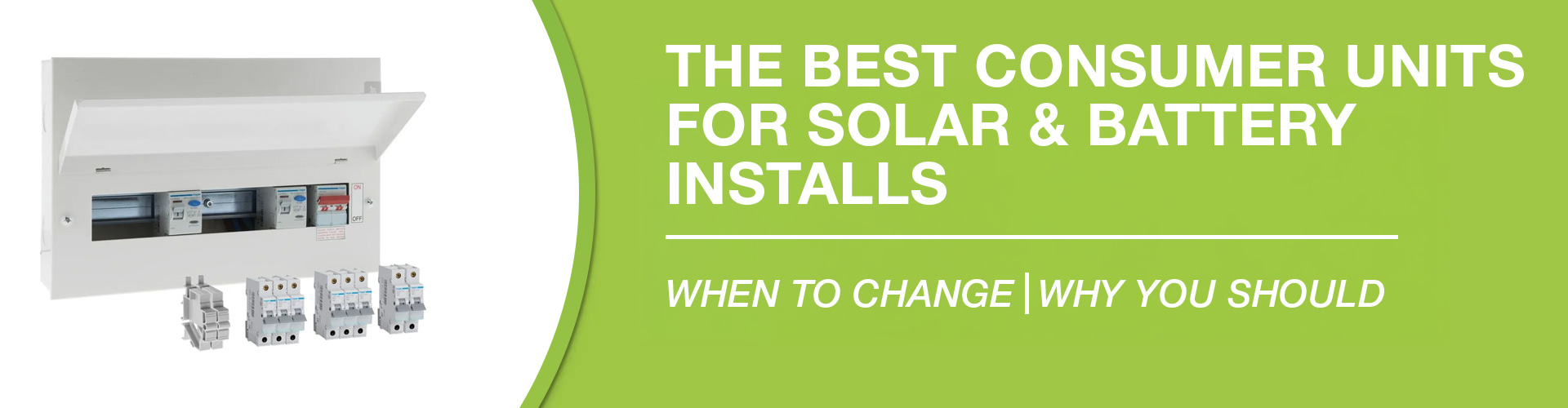
As solar panels and home battery storage become more common across the UK, one upgrade is often overlooked: the consumer unit.
Whether you’re adding solar PV, battery storage or installing both under schemes like the Warm Homes Plan, the existing board needs to be assessed for capacity, compliance and future expansion. In many cases, a full upgrade is the safest and most professional solution.
This guide explains what to look for — and which consumer units are best suited to solar and battery installations.
Why Solar & Battery Installs Often Require a Consumer Unit Upgrade
Adding solar PV or battery storage introduces:
- New dedicated circuits
- Bidirectional energy flow
- Higher load demand
- Surge protection requirements
- Additional RCD/RCBO considerations
Older split-load boards or plastic enclosures are rarely suitable for modern renewable installs. Since Amendment 3 of BS 7671, consumer units in domestic properties must be non-combustible (metal) — and most renewable jobs require:
- Individual RCBO protection
- Spare ways for future expansion
- Type 2 SPD (Surge Protection Device)
- Clear labelling and circuit separation
If you’re installing solar or batteries professionally, upgrading the board often protects you from nuisance tripping, non-compliance issues and callbacks.
What to Look for in a Solar-Ready Consumer Unit
1. All RCBO Configuration
Solar and battery systems are best installed on individual RCBOs rather than shared RCD banks.
This prevents:
- Entire banks tripping due to DC leakage
- Cross-circuit interference
- Fault-finding headaches
- Look for boards that support full RCBO population.
2. Built-In or Compatible Type 2 SPD
Solar arrays are particularly vulnerable to transient overvoltage.
A consumer unit with integrated or easily addable Type 2 SPD helps protect:
- Inverters
- Battery management systems
- Smart controls
- Household electronics
SPD is not optional on many new installs under current regulations.
3. Ample Spare Ways
Solar + battery can take 2–4 ways depending on configuration:
- PV inverter supply
- Battery inverter supply
- Backup circuits (if hybrid)
- Future EV charger
Choosing a 12–18 way board provides flexibility for future electrification (EVs, heat pumps, etc.).
Best Consumer Units for Solar & Battery Installs
Below are reliable, installer-approved boards suitable for renewable integration.
Hager Consumer Units
Hager boards are a popular choice for renewable installs thanks to solid busbar design and RCBO flexibility.
Why they work well for solar & batteries:
- Full RCBO configuration
- High build quality
- SPD compatibility
- Strong brand trust in domestic installs
Ideal for installers who want neat layouts and long-term reliability.
BG Fortress Consumer Units
BG Fortress boards offer excellent value while remaining fully compliant and metal-clad.
Key benefits:
- Cost-effective renewable-ready solution
- Type 2 SPD options available
- Good spare way flexibility
- Suitable for domestic retrofits
A strong option when balancing performance and budget.
FuseBox Consumer Units
FuseBox has become a go-to for many electricians installing solar and batteries.
Why installers choose FuseBox:
- Fully populated RCBO boards available
- Competitive pricing
- Integrated SPD options
Particularly suitable for retrofit solar + battery upgrades where the existing board needs full replacement.
When Should You Definitely Replace the Board?
Consider upgrading if the existing unit:
- Is plastic (pre-Amendment 3)
- Has no spare ways
- Is split-load with shared RCDs
- Lacks surge protection
- Is over 15–20 years old
For solar and battery installs, upgrading the consumer unit is often safer, cleaner and more future-proof than trying to squeeze into an outdated board.
Futureproofing for Electrification
Solar and batteries are rarely installed alone. Many homeowners will soon add:
- EV chargers
- Heat pumps
- Smart heating controls
Choosing an 18-way metal board with SPD and full RCBO configuration now prevents a second upgrade later.
It also positions you professionally as an installer who designs for the future — not just today’s job.
Final Thoughts
The best consumer unit for solar and battery installs is:
- Metal-clad
- SPD-protected
- RCBO-configurable
- Spacious enough for expansion
- From a reputable brand
Electricpoint stocks Hager, BG Fortress and FuseBox boards suitable for renewable installations, along with matching RCBOs and surge protection devices — making it easy to source everything for a compliant job in one place.
If you're preparing for increased renewable demand under the Warm Homes Plan, upgrading consumer units correctly is one of the smartest ways to ensure safe, regulation-compliant installations.