




EV Charging Guide
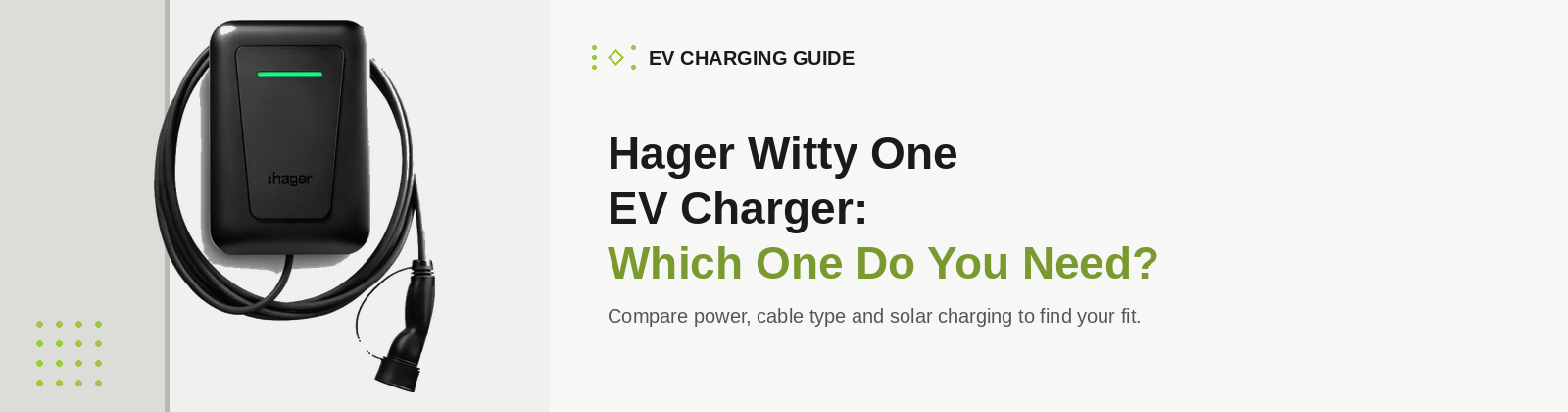
Hager Witty One EV Charger: Which One Do You Need?
Hager has long been a trusted name in electrical distribution and safety equipment, and that reputation now extends to home and business EV charging with the Hager Witty One EV charger range. Available at Electricpoint in both 7kW and 22kW power outputs and in tethered or untethered versions, the Witty One is designed to give homeowners, landlords and businesses a flexible, reliable way to charge an electric vehicle.
If you're comparing EV chargers for a house, a workplace car park, or a rental property, this guide walks through the differences between the Witty One variants, what solar compatibility means in practice and how to work out which model fits your setup. You can browse the complete lineup on the Hager EV chargers category page.
Witty One at a glance: standout features
01
Screenless, app-driven design
No fiddly on-unit display — setup, monitoring and control all happen through the free Hager Charge App via Bluetooth, for fewer physical components to fail, a cleaner look and faster commissioning.
02
Flexible mounting, no wall required
Wall-mount as standard, with a sturdy free-standing pedestal available as a separate purchase — useful for driveways, car ports or flats with allocated parking where there's no suitable wall.
03
Available in 7kW or 22kW
Choose 7kW on a single-phase supply for everyday home charging, or 22kW on three-phase for faster turnaround in workplace and fleet settings — one product family covering both.
04
Built-in dynamic load management ready
Compatible with load balancing accessories to share power across multiple chargers or avoid tripping the main fuse, without needing a separate add-on.
05
RFID + app access control as standard
Secure charging via RFID badge or app, useful for shared driveways, HMOs, or small commercial and fleet use, not just single-household domestic.
06
Solar/PV integration
Supports smart/solar charging modes, letting you charge from excess PV generation if you already have or are considering solar panels.
07
Optional white cover available
Comes in black as standard, with a white front cover available to purchase separately — a point of difference for anyone who cares about kerb appeal versus a fixed all-black unit.
08
Backed by Hager's UK trade reputation
Comes from a manufacturer electricians already trust and stock for consumer units and circuit protection.
09
IP-rated for indoor or outdoor install
Suitable for exposed locations without extra housing, useful for driveway or external wall installs.
What is the Hager Witty One EV charger?
The Hager Witty One is a wall-mounted (or pedestal-ready) charging station built for everyday residential and light commercial use. It's controlled through the Hager Charge mobile app, which lets you start and stop charging sessions, schedule off-peak charging and monitor your consumption from a smartphone. Access can be managed via RFID card or Bluetooth, which is useful for shared driveways, workplace car parks, or any site where you want to control who can use the charger. For a closer look at how features like this fit into the bigger picture of scheduling, load management and energy tariffs, see our guide to smart EV chargers.
Build quality is one of the reasons installers and buyers keep coming back to Hager. The Witty One is weatherproof and designed for outdoor installation as standard, so it holds up whether it's mounted on an exterior wall or a free-standing pedestal.
Choosing your Witty One: power, cable & compatibility
Every Witty One is a combination of power output and cable type, so it's worth understanding what each option means before you specify one.
01 — 7kW
Single-phase, everyday home charging
Runs on the single-phase supply most UK homes already have, adding around 25-30 miles of range per hour — enough to fully replenish most electric cars overnight.
02 — 22kW
Three-phase, faster turnaround
Requires a three-phase supply, far more common in commercial settings, and cuts charging times significantly for vehicles that can accept that input — ideal for fleets and staff parking.
03 — Tethered
A cable that's always ready
A charging cable is permanently attached to the unit, so you simply unwind it and plug in — no separate cable to store or forget.
04 — Untethered
Flexible for multiple vehicles
A socket on the front lets you connect your own Type 2 cable, which suits households or businesses running more than one EV or cable length.
Hager Witty One 7kW vs 22kW: which power output do you need?
The most important decision when choosing a Hager Witty One 7kW or Hager Witty One 22kW unit is matching the charger's output to your electricity supply and your daily mileage — for a broader look at this trade-off across chargers generally, see our guide to 7kW vs 22kW EV chargers.
Hager Witty One 7kW runs on a single-phase supply, which is what most UK homes have. A 7kW charge point typically adds around 25-30 miles of range per hour, which is more than enough to fully replenish most electric cars overnight. If you're installing a home EV charger and don't have a three-phase electricity supply, the 7kW model is usually the practical choice.
Hager Witty One 22kW requires a three-phase power supply, which is far more common in commercial and workplace settings than in domestic properties. A 22kW charger can cut charging times significantly for vehicles capable of accepting that input, making it a strong option for fleet vehicles, staff parking, or any site with regular vehicle turnover. If you're specifying a workplace EV charger for multiple staff or visitor vehicles, the 22kW Witty One is worth serious consideration, though it's worth confirming with your installer that your building's electrical supply can support it. If you're a UK business considering workplace charging, it's also worth checking whether you're eligible for government funding through the Workplace Charging Scheme (WCS).
Tethered vs untethered: choosing the right Hager Witty One for you
Alongside power output, every Witty One is available as either a tethered unit or an untethered unit, and this decision comes down to convenience versus flexibility — we cover the general pros and cons in our tethered vs untethered EV chargers guide.
A tethered charger has a charging cable permanently attached to the unit. You simply unwind the cable and plug it into your car, with no separate cable to store or forget. This tends to suit households with one car, or anyone who wants the fastest, simplest connection every time they charge.
An untethered charger has a socket on the front instead of a fixed cable, and you connect using your own Type 2 charging cable. This is a popular choice for households or businesses with more than one EV, since different vehicles or different cable lengths can be used with the same charge point. It also keeps the unit tidier when it's not in use, since there's no cable hanging on the wall.
Both configurations are available across the tethered EV chargers and untethered EV chargers ranges. For the Witty One specifically, you can view each combination here:
- Hager Witty One 22kW Untethered EV Charger
- Hager Witty One 22kW Tethered EV Charger
- Hager Witty One 7kW Untethered EV Charger
- Hager Witty One 7kW Tethered EV Charger
Solar compatibility: the Hager Witty One as a solar EV charger
One of the standout features of this range is that every Witty One model is solar compatible. In practice, this means the Witty One can work alongside a home solar PV system to prioritise charging your vehicle with self-generated electricity rather than pulling entirely from the grid. Combined with the Hager Charge app's scheduling features, this allows for smarter, more cost-effective charging that adapts to when your solar panels are actually producing power, rather than charging on a fixed schedule regardless of supply.
For anyone who already has solar panels installed, or is planning an EV charger install alongside a new solar system, this compatibility is a meaningful long-term saving.
Home vs workplace use: matching the Witty One to your setup
Because the Witty One range spans both 7kW and 22kW outputs, it works equally well for domestic driveways and commercial car parks, but the right specification depends on the setting.
For a single-vehicle household, a home EV charger in 7kW tethered form usually covers daily charging needs without complication. Multi-vehicle households often prefer the untethered version so different cables can be used as needed.
For businesses, landlords with multiple parking bays, or sites managing several vehicles, the case for a 22kW charger is stronger, particularly where three-phase power is already available and faster turnaround between vehicles matters. RFID access control also becomes more useful in shared settings, since it allows you to restrict charger use to authorised staff or tenants.
Installation considerations
As with any home or commercial EV charger, installation should be carried out by a qualified electrician who can confirm your existing electrical supply, consumer unit capacity, and any additional protection required for the circuit. This is particularly relevant for the 22kW Witty One, since a three-phase supply is a prerequisite rather than an optional extra. Your installer will also be able to advise on wall-mounted versus pedestal installation depending on where you want the charge point positioned.
Watch: how to install the untethered Hager Witty One
Prefer to see it in action? The video below walks through a full untethered Hager Witty One installation from start to finish — useful if you want to know what to expect before your electrician arrives, or if you're an installer looking for a quick refresher on this specific unit.
Finding the right Hager Witty One for your charging needs
Whether you need a straightforward 7kW tethered charger for a single-car household, a 22kW untethered unit for a workplace car park, or a solar-compatible charger that adapts to your own generated electricity, the Hager Witty One range is built to cover it.
Explore the Hager Witty One Range →Not sure which output or cable type is right for your installation? Give our team a call on 0203 994 5470, email sales@electricpoint.com, or use our Contact Form — and don't forget to ask about our Price Promise on your order.