




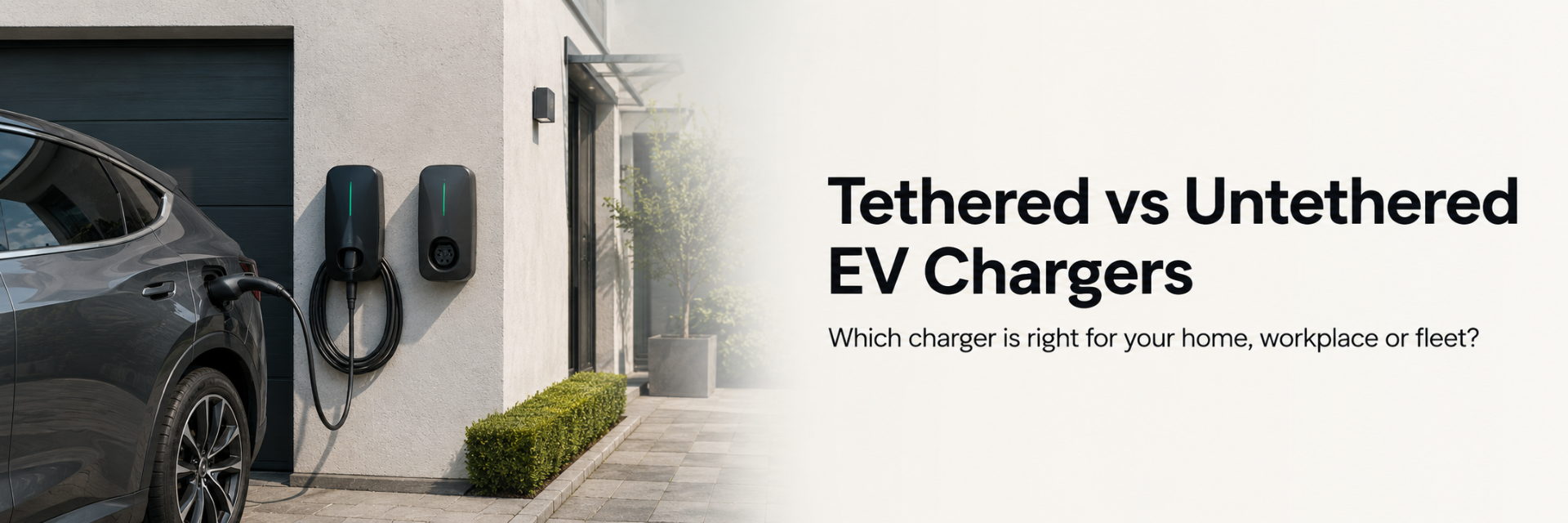
Choosing an EV charger is a big decision and one of the first questions most buyers ask is: "Should I get a tethered or untethered charger?" The difference is simple on the surface — one has a fixed cable attached, the other is a socket that uses your car's own charging cable. But the real choice comes down to convenience, flexibility, security and how you plan to use the charger.
What Is a Tethered EV Charger?
A tethered EV charger has a charging cable permanently attached to the unit. When you park, you simply take the connector from the charger and plug it into your car — no need to bring your own cable.
What Is an Untethered (Socketed) EV Charger?
An untethered or socketed EV charger has no fixed cable. Instead, it has a Type 2 socket and you use the charging cable that came with your electric car (or a separate one).
Tethered vs Untethered EV Charger Comparison
Here's a clear side-by-side comparison:
| Feature | Tethered EV Charger | Untethered (Socketed) EV Charger |
|---|---|---|
| Convenience | Excellent – just plug in | Good – must bring your cable |
| Aesthetics | Cable hangs when not in use | Much cleaner look |
| Cable Damage Risk | Higher (especially in public or workplace) | Lower |
| Cable Replacement | Expensive (often requires service) | Cheap and easy |
| Best For | Homes with 1–2 regular EVs | Workplaces, fleets, visitor parking |
Best Use Cases for Tethered Chargers
Tethered chargers are ideal when convenience is the top priority.
- Domestic homes with one or two EVs that park in the same spot regularly
- Households where the driver doesn't want to carry a heavy cable every day
- Dedicated staff parking bays at smaller workplaces
- Situations where the charger is mounted close to the parking space
Best for: Most homeowners and simple workplace setups.
Best Use Cases for Untethered Chargers
Untethered chargers win when flexibility and security matter more.
- Workplaces and business premises with multiple users and different vehicles
- Fleet charging where many different EVs come and go
- Visitor or customer parking bays
- Properties with mixed personal and company vehicles
- Locations where cable theft or vandalism is a concern
Best for: Commercial, workplace, and mixed-use scenarios.
Tethered vs Untethered for Different Scenarios
For most households, a tethered charger is the more convenient choice. You park in the same spot every night, so the fixed cable becomes a time-saver rather than a hassle.
This is where untethered chargers often perform better. Employees and visitors drive different cars, and untethered units reduce cable management issues and theft risk.
Untethered chargers are usually the smarter choice here. They offer maximum flexibility and make it easier to manage multiple vehicles with varying cable lengths.
Other Important Factors to Consider
Cable Length
Tethered chargers typically come with 5m, 6m or 7.5m cables. Make sure the cable reaches your car's charging port comfortably.
Aesthetics
Many homeowners prefer the cleaner look of an untethered unit on the side of their house.
Future-proofing
If you expect to change cars frequently or add more EVs later, untethered gives you more flexibility.
Vandalism & Theft Risk
In open or semi-public areas, untethered chargers significantly reduce the chance of cable damage or theft.
Ready to Choose Your EV Charger?
Browse tethered or untethered EV chargers:
Or explore our popular categories